
Breastfeeding positions with a sling carrier
Wearing our baby in a sling greatly favours breastfeeding. The skin-to-skin contact we share helps both the baby’s easy access to the breast and the mother’s ability to “read” her baby’s “messages” better, to notice from the very start the first signs that her baby wants to feed. Moreover, this close contact helps the release of oxytocin, which is particularly important for breastfeeding!
Beyond that, however, with a sling carrier we can make breastfeeding especially easy in some positions that might otherwise be awkward or require lots of pillows. Of course, moments of breastfeeding are beautiful, and it is well worth it for mother and baby to devote themselves to that alone. Nevertheless, since not all of us have the luxury of breastfeeding comfortably seated on our sofa, and if one considers the total amount of time mother and baby spend breastfeeding throughout the day, it is easy to understand how important it is for a mother, while she is breastfeeding, to be able to drink a glass of water, answer a ringing phone, help her older child, or open the door, without having to interrupt the feeding.
So let’s look at some of the most common breastfeeding positions in a ring sling:
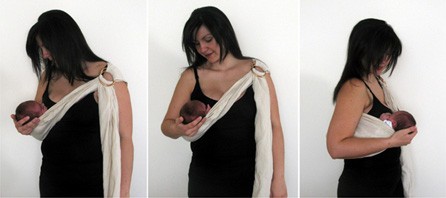
Classic position: Baby lying down with the head opposite the rings
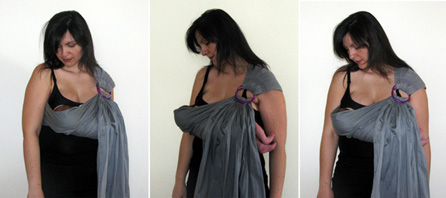
This is the most common breastfeeding position in a sling carrier. It is suitable for babies from the first day of their life until about two years old. It is also the position that offers the greatest flexibility: we can raise the baby’s head separately from the legs, and achieve exactly the position that suits us (depending on the size of the baby or the mother’s breast, etc.).
The baby is turned completely towards the mother (tummy to tummy), the baby’s little hand is usually either under its body or under the mother’s breast, and the baby’s ear, shoulder and thigh are in a straight line.
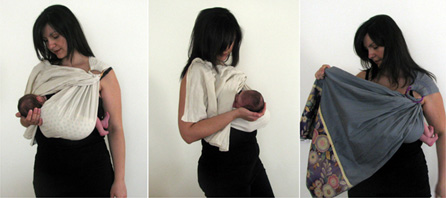
Even though, as shown above, the mother could have her hands free while breastfeeding, for very small babies who don’t yet support their head and who are still learning to breastfeed (like my own in the photo, who is 5 days old), it is important for the mother to make sure the baby “latches” perfectly onto the breast. That is why we suggest that for small babies the head should not go inside the sling, but rather the mother should support it with her hand or with the inside of her elbow. At this stage (and at this age), accuracy is sometimes a matter of a millimetre, and in this way the mother has exactly the control she needs, while she still has at least one hand free, is comfortable (the sling carries the baby’s weight), and can move and get things done as she wishes.
In case of breastfeeding in a public place, if the mother wishes, she can use the tail for coverage. She could cover the baby’s whole head or cover only the upper part of the breast. This way she can comfortably watch her baby breastfeed and make sure it is feeding well, without feeling exposed. (Whichever way you choose to use your sling’s tail for coverage, you must be able to maintain visual contact with your baby at all times!)
Watch a video of the classic breastfeeding position here
Football hold position: Under the arm, with the baby’s tummy resting against the mother’s ribs.
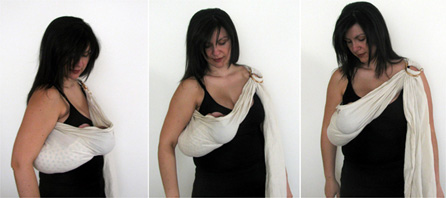
Normally this position requires lots of pillows, but in a sling it is very easy and very comfortable and offers quite a lot of precision in positioning. It is convenient for mothers who gave birth by caesarean and want to leave their tummy completely free, it is ideal for mothers who are learning to breastfeed, and it is also suitable for sleepy or restless babies. What’s more, in cases of mastitis or blocked ducts, where the baby needs to breastfeed with its chin resting on the sore spot, this position can be a very good solution!
In general, it’s a good idea for the baby to breastfeed in different positions, thereby stimulating the breast very well.
As with the previous position, if needed, the mother may prefer to support the baby’s head with her hand at first, until both get used to breastfeeding in this position. This position is suitable for babies from the first day of their life until about 3 months old.
Upright baby: below the mother’s breast
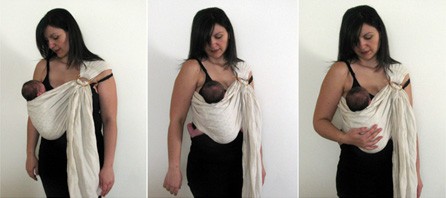
Starting from the seated position with the legs out, the baby goes lower and is placed in line below the mother’s breast, from where it breastfeeds in an upright position. It is an ideal position for babies with reflux who need to feed upright, or for babies who wear a double nappy or need to have their little legs open for their hips. Again, as long as the baby does not support its head, it is important for the mother to make sure the baby’s positioning at the breast is correct (the baby’s chin rests properly against the mother’s breast and the head does not tilt forward).
This position is suitable for babies from the first day of their life until about two years old.
Watch a video of the upright breastfeeding position here
Baby lying down: With the head on the same side as the rings
Some mothers find that in this position it is easier to have their hands completely free and to control the position of the baby’s head better. However, in this position the mother does not have control over the position of the baby’s body (e.g. she cannot raise or lower the legs), and often how comfortable each mother feels with this position depends largely on the size of the breast. It is, however, an easy position, suitable for babies from the first day of their life until about 3 months old.
Watch a video of the “reverse” breastfeeding position here
Note: For all the positions above, it is important to follow all the general instructions for positioning the baby for breastfeeding.
For any matter related to breastfeeding, consult a certified Lactation Consultant (IBCLC), or the Breastfeeding Association of Greece.
Useful links about breastfeeding (in Greek):
http://www.paidiatre.gr/thilasmos.html
http://www.mitrikosthilasmos.com/