
Contents
- What should I look for when choosing a baby carrier?
- What do we mean by an «ergonomic carrier»?
- From what age can I «wear» my baby?
- Can I carry my baby facing outward in an ergonomic carrier?
- Up to what age can I carry my child?
- How long can I keep my baby in the carrier?
- Can a mother who had a C-section wear her baby?
- Are there cases where using a carrier helped with special breastfeeding situations (reflux, re-lactation)?
What should I look for when choosing a baby carrier?
The goal of a carrier is to make our life easier. For it to be practical and comfortable, we should choose it keeping a few key points in mind.
- It should adjust exactly the way I want. We often say: «The carrier must adjust to the baby. Not the baby to the carrier.» I should be able to place my baby a little higher or lower, a bit tighter or looser, with the head more in or more out. And I should be able to do this while I am wearing it, without taking it off.
- I should be able to put it on without help. If I needed help, I would just say «hold the baby while I get things done»! That is exactly why I want a carrier — so I don’t need help. It must be easy to put on and not take much time.
- It should suit me. Choosing a carrier is a very personal matter. What worked for my friend may not work for me. Some prefer tying, others prefer buckling.
- It should be high-quality and ergonomic. I need peace of mind that my baby is definitely safe, in the correct position. The materials must be safe, tested and suitable for babies.
What do we mean by an «ergonomic carrier»?
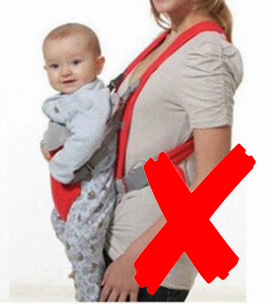
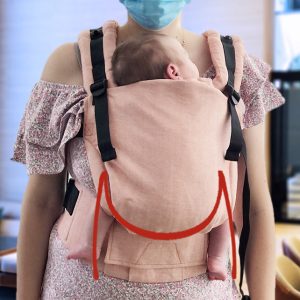
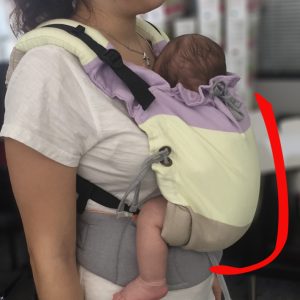
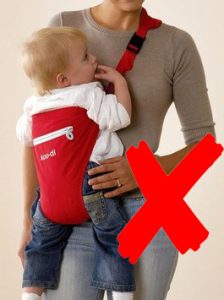
An ergonomic carrier lets the baby keep their natural posture, just as they would in our arms. In the correct posture, the baby has their knees apart (at about a 90° angle), their knees high (in small babies always higher than the bottom) and the lower back gently curved.

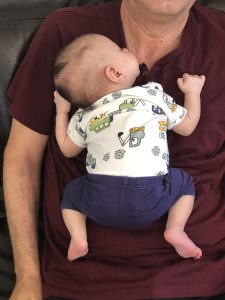
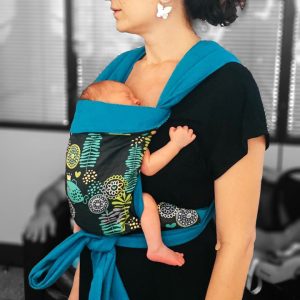
In an ergonomic carrier the baby does NOT hang from the crotch. We don’t want a straight back, closed knees, or legs stretched downward.
An easy way to recognise it: you can see two shapes — an M from the front and a J from the side.
From what age can I «wear» my baby?

In theory, since a carrier is a hug, the answer is «from day one». With a wrap (woven or stretchy), a ring sling, or some mei tais, we can wear our baby from the very first day.
There are, however, carriers (usually with buckles) that are pre-adjusted, for which we must follow the manufacturer’s guidance on age/weight limits. Usually the restriction has to do with how far the carrier can be downsized.
Can I carry my baby facing outward in an ergonomic carrier?
Just like with car seats: with the right carrier and at the right age, yes. We can carry the baby facing outward if the carrier supports that position. When done correctly: the spine gently curved, the pelvis tilted forward, the legs supported from knee to knee.
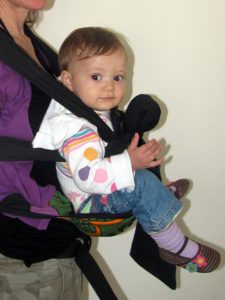
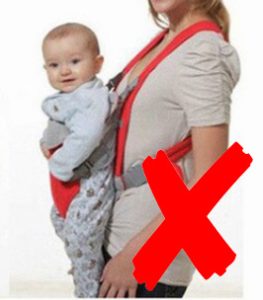
Generally, though, there are several reasons why facing out is not recommended. There are much better positions for the baby to look around. With a good carrier the baby is not «closed in» — they can easily see and take part, even when facing inward.

Up to what age can I carry my child?
The general answer is «as long as I can manage and as long as we both want to».
Again, it depends on the carrier and its specifications. Usually the limits set by the manufacturer are not about the carrier’s strength, but about the endurance of the person wearing it. When it says e.g. «up to 20 kg», it doesn’t mean the carrier will break at 21 kg — it means it’s not right for us to carry that much weight for a long time.
A child may want to be held even long after they start walking. Most ergonomic carriers support this. But in the end it depends on our own endurance.

How long can I keep my baby in the carrier?
In an ergonomic carrier the baby is in a perfect position. So for the baby there is no time limit. Consider that there are babies who wear a special orthopedic brace in exactly this position (and wear it all day long!).
The only limit is ours — our own stamina. In practice, we very rarely hold the baby in our arms for a long stretch without sitting down. We say «I hold them all day» — but in reality, holding them without sitting lasts five to ten minutes at a time.
With a good carrier we might «lose track»: it is so comfortable that we wear it continuously for much longer, doing other things at the same time, and the time flies. But only we know our own limits.
Can a mother who had a C-section wear her baby?
Yes, of course. If she can hold her baby in her arms, she can just as well wear them in a good carrier. Besides, especially at a young age, the baby sits very high on our body — nowhere near the incision.
The only thing she should watch is her own stamina, just like every mother after birth.
Are there cases where using a carrier helped with special breastfeeding situations (reflux, re-lactation)?
Yes — but to put it precisely, what really helps is the hug itself. Holding our baby is what helps: us with our hormones, our baby, the connections in the brain, the baby’s development. A carrier makes the hug easier, and therefore more frequent.
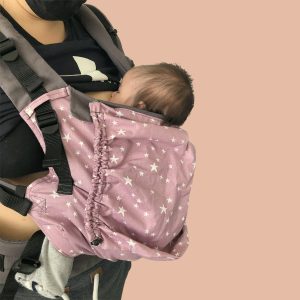
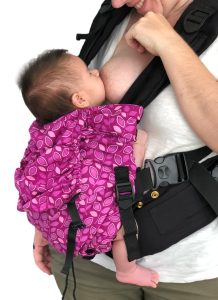
It helps mothers overcome the postpartum «blues», supports the release of oxytocin (which is directly involved in the breastfeeding mechanism), helps with bonding with the baby, and reduces stress.
In nursing twins or tandem nursing (breastfeeding a baby and a toddler at the same time) the carrier is a lifesaver. It is important not to need ten pillows to hold the baby, e.g. upright to feed in cases of reflux. It is important to be able to easily hold the baby in the position that helps mastitis clear up.

And other cases too: nursing with nipple shields or with a supplemental nursing system — the carrier helps the mother keep her hands free.
You may also like
Babywearing Basics
Can I Wear My Baby After a C-Section?