Open legs in babies — hips and healthy development
Article from the Babywearing blog, published on 05/03/2010

Why we want the legs open and the knees high
Having already discussed the upright position (even for newborns), let’s clear up another misunderstanding. Parents often ask “but is it okay for the legs to be so open?” or avoid carrying their small baby with the legs out so they won’t be open.
The answer is that doctors say we want the baby to have its legs open and knees high. It’s the most suitable position for healthy development.
A good “proof” of this is that this very position is used as treatment when a problem does exist — for example, when hip dysplasia is diagnosed. In most cases the treatment involves a special brace or harness that holds the little legs open and bent upward, as in the photos below:
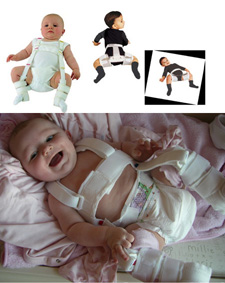
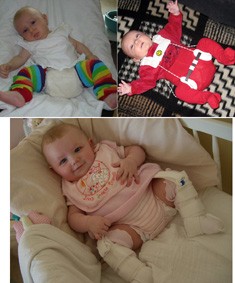
Does it remind you of something? It’s exactly the same position the baby is in inside an ergonomic carrier!
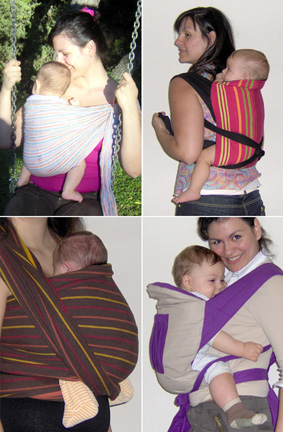
The difference with conventional carriers
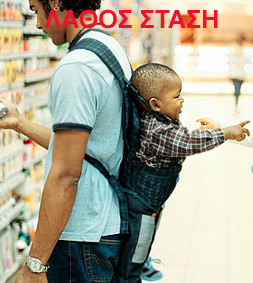
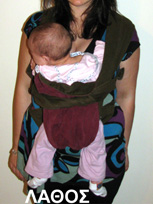
See the difference with the conventional carriers you find in baby-goods shops: the legs dangle straight down and the weight is distributed completely differently.
Have you heard of milder cases (e.g. when the baby was in a breech position) where the pediatrician recommends a double diaper? The reason is always the same: to keep the legs open, so the head of the femur sits correctly in the socket of the pelvis *.
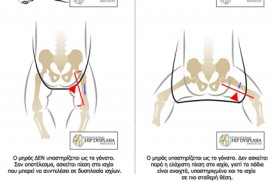
The images above are translated from the International Hip Dysplasia Institute and describe very nicely the same points about carriers and the hips.
How the Asteraki mei tai supports correctly
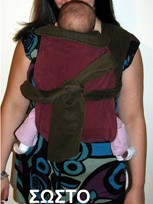
The way Asteraki carriers are made (with the lower straps at an angle) lets the mei tai “cinch” as much as we want between the baby’s legs. We could make it so narrow that the legs would “dangle” — but that isn’t the goal! The right thing is for the leg to be supported along the whole thigh, up to the knee. The mei tai should open exactly as wide as the baby’s legs spread (depending on age and weight).
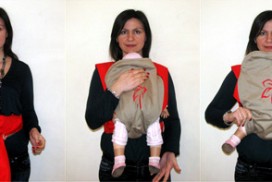
Watch in detail in the video how open the baby’s legs are and why this position is perfectly suitable for newborns (only with an Asteraki mei tai):

“If the legs are bent more than 90° (about 100-110°) and spread approximately 90°… the femur head fits ideally in the hip socket. This favors its healthy development.” — Dr. Evelin Kirkilionis, FVM, Freiburg/Germany, mothering magazine, Jul/Aug 2006, No 136.
This is only possible if the sling has NO padding at the edges (otherwise it can’t fit under a newborn’s folded little knees).
See the photos
Just like in your arms

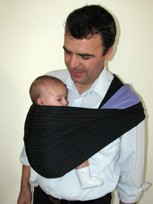
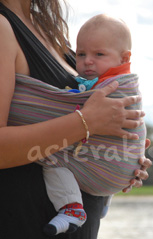
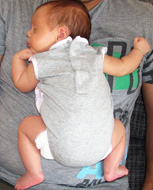
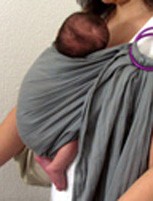
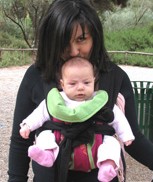
Minding the support
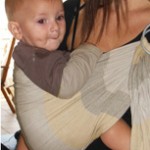
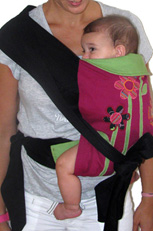
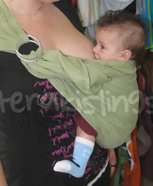
If your mei tai is an Asteraki, you can cinch it as much as you like between the baby’s legs. Just don’t make it narrower than the spread of the knees! You want the legs supported up to the knee, so the baby doesn’t “dangle” with the legs down, as in conventional carriers: