Myths about babywearing
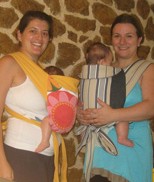
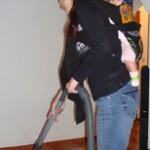
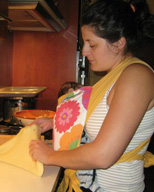
The most common fears about babywearing are in reality myths and are far from the true picture. Babies do not get spoiled in our arms and babywearing is in no way an obstacle to their development.
Will I “spoil” my baby if I wear them?
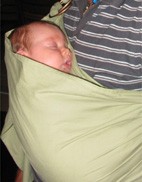 No! It is impossible to “spoil” a baby, because the only way they know to get your attention is by crying. The need for contact and security is one of the most basic ones your baby has and it should simply and naturally be met. Research has shown that the less a baby cries during the first year of their life, the less they will cry later on too! And look at this:
Babies who spend several hours of the day in a sling cry 43% less overall and 54% less at night.
No! It is impossible to “spoil” a baby, because the only way they know to get your attention is by crying. The need for contact and security is one of the most basic ones your baby has and it should simply and naturally be met. Research has shown that the less a baby cries during the first year of their life, the less they will cry later on too! And look at this:
Babies who spend several hours of the day in a sling cry 43% less overall and 54% less at night.
Hunziker, U. A. and Barr, R, G. (1986). Increased carrying reduces infant crying: a randomized controlled trial. Pediatrics, 77, 641-8
Furthermore, in societies where wearing your baby is the usual practice (and babies spend almost the whole day in some kind of cradle carrier), babies cry less than in societies where babywearing is not customary.
Barr, R. G. (1990). The Early Crying Paradox: A Modest Proposal. Human Nature, 1, 355-389 Lee, K. (1994). The crying pattern of Korean infants and related factors. Developmental Medicine and Child Neurology, 36, 601-7. LeVine, R.A., LeVine, S., Dixon, S., Richman, A., Leiderman, P.H., Keefer, C. and Brazelton, T.B. (1994). Child Care and Culture: Lessons from Africa. Cambridge: Cambridge University Press.
read more: “Holding is a natural instinct!”
Will my child be late to walk if I wear them?
On the contrary! The movement that is by definition part of babywearing helps the child’s physical and motor development. Moreover, babies who spend enough time in a cradle carrier become more independent at a younger age. They quickly develop a sense of security and trust and are more likely to form bonds early and firmly with the people who wear them. This way they are eager to take their first steps with confidence when the time comes!
Anisfeld, E., Casper, V., Nozyce, M. and Cunningham, N. (1990). Does infant carrying promote attachment? An experimental study of the effects of increased physical contact on the development of attachment. Child Development, 61, 1617-1627
Whiting, J. W. M. (1981). Environmental constraints on infant care practices. In R. H. Munroe, R. L. Munroe & B. B. Whiting (Eds.), Handbook of cross-cultural human development, New York: Garland STPM Press.
read more: “With stimuli for our baby”
I see red marks on the baby’s legs where they touch the sling, is this a bad thing?
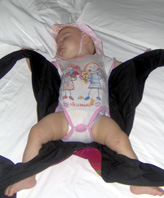 No! Consider that you can also see red marks on the little cheeks of a baby who was sleeping comfortably on the sheet or the pillow! The same can happen with comfortable cotton socks!
Imagine sitting in your swimsuit on a wicker chair: when you get up you will most likely have red marks on your legs, but this does not mean that all the time you were sitting you did not feel comfortable.
In any case, one way to avoid red marks on the plump little thighs is to make sure you wear your sling correctly (be careful that the bottom is at least at the same height as the baby’s knees or lower. This way almost no weight is put on the baby’s legs).
In any case, trust your baby: they will let you know if they do not feel comfortable!
No! Consider that you can also see red marks on the little cheeks of a baby who was sleeping comfortably on the sheet or the pillow! The same can happen with comfortable cotton socks!
Imagine sitting in your swimsuit on a wicker chair: when you get up you will most likely have red marks on your legs, but this does not mean that all the time you were sitting you did not feel comfortable.
In any case, one way to avoid red marks on the plump little thighs is to make sure you wear your sling correctly (be careful that the bottom is at least at the same height as the baby’s knees or lower. This way almost no weight is put on the baby’s legs).
In any case, trust your baby: they will let you know if they do not feel comfortable!
See the video below that explains very well how the baby feels in a cradle carrier:
read more: “Hugging the baby from all around!”
Images & video