
How to breastfeed your baby in your sling
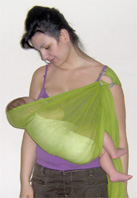
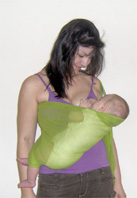 In the photo on the left, Rea is 6.5 months old and breastfeeds very comfortably in the cradle position. I am using a sling made of cotton gauze so that you can see the baby’s position.
Note: If your baby is very small they can breastfeed directly from the “cradle” position, with their legs completely inside the sling (and the head on the same side as the rings). It is, however, easier to bring them into the correct breastfeeding position if their little legs are free on the other side.

 If your baby supports their head well, they can also breastfeed in the seated position. In this photo, the sling is made of cotton gauze and you can clearly see the way the baby (6.5 months old) sits in this position while breastfeeding. This is a very good breastfeeding position for babies with gastroesophageal reflux!
read more: “Breastfeeding a baby in a ring sling, with video”
read also: “Breastfeeding a baby in a soft carrier”
Important note: If your baby spends a lot of time on you, this greatly helps your bond and your ability to immediately recognize the “signs” that your baby wants to breastfeed. If you wear them in a sling, this will also make breastfeeding easier and more comfortable, especially if your baby wants to breastfeed very often at the beginning.
However, breastfeeding your baby on the sofa is a “lesson for beginner mums”. Breastfeeding your baby in a sling is a lesson for “advanced babywearers”! First you and your baby need to “learn” breastfeeding, and then use your sling to help you.
The combination of breastfeeding and babywearing is a specialized skill and requires attention and experience. The “rules” of breastfeeding that you follow will apply here too (correct positioning of the baby, correct breathing, correct “latch” at the breast, unobstructed nostrils, etc.).
See in the video below how easy the transfer from the upright position to the cradle/breastfeeding position is:

Notice how comfortably and quickly I bring the baby into the position I want: I lower the head to the height I want, I raise the legs to the height I want. Every mum (and every baby) has their own preferences, especially for breastfeeding, depending on her habits (but also her body, the size of the breast, etc.). The free adjustment of the sling into the appropriate position, while the baby is already inside, is important! This can only be done with a sling with an open tail and without padding on the edges.
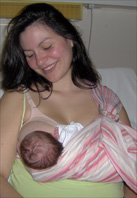
This position is suitable for babies from the first day after their birth. You can breastfeed your baby in the ring sling while even having great freedom of movement.
By using the tail as a “cover”, you can breastfeed discreetly even in a public place without anyone being able to see that your baby is eating.
See all the breastfeeding positions with a ring sling here!
Below follow corresponding instructions with photos. Note: In the photos below the “model” is my Rea, at the age of 8 months!
1. Put your sling on as usual and hold your baby in your arms, high on your shoulder, with the opposite hand from the one on which you have the rings.
2. Then pass their legs between the sling and your body (so that they come out from the lower side). Stretch the fabric by pulling with your hands the lower part down under the baby’s knees and the upper part high up on their back.
3. Grab the baby’s little legs and bring them both to the side where the rings are, laying your baby down.
4. Continue to support their head if needed and bring your baby into the position needed to breastfeed: their head in line with their back, their whole body turned towards your breast. (If it is more comfortable for you, you can be seated up until the next step for better control.)
5. Help your baby to “latch” correctly and to start breastfeeding. (To put your baby to the breast, you should make all the movements as if you did not have the sling around them and of course you should be holding them continuously up to here.)
6. Now you can start to stretch the fabric by pulling the tail, until it becomes as tight as you want. If your baby is very small and is now learning to “latch” correctly, you can continue to support their head with the inside of your elbow.
7. By pulling the outer side of the tail, you can raise the baby’s legs higher.
8. By pulling the inner side of the tail, you can raise the baby’s head higher. Your ring sling offers this unique flexibility, to bring the child exactly into the position you need, which is why it is the ideal carrier for newborn babies who breastfeed.
9. You can also raise the child’s little back higher if needed, by pulling the tail from its center. Notice that with one hand I support the baby’s weight in the position I want it to stay, and with the other I pull the tail until I achieve it.
10. Now your baby is eating and you have your hands free.
Note: I lift the sling’s tail so that you can see that the baby’s legs come out on the other side of the sling. This is safe, as long as the fabric is spread out up to their knees.
If you need to breastfeed in a public place or in front of people, you can use the tail to cover the baby and whatever parts of your body are exposed! (This also helps if your baby is easily distracted and often interrupts breastfeeding to see what is happening around them!) You must, however, be able to see your baby at any moment and make sure they are eating well.