
Newborn babies in a cradle carrier — Breathing and the spine
Article from the Babywearing blog, published on 25/05/2011
The spine isn’t straight — it has curves
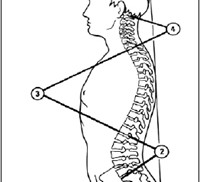
As you know, our spine (seen from the side) isn’t a straight line — it has curves that help us move flexibly, keep our balance and withstand the pressure our daily activities, running and walking put on the body. (*)
These curves, however, are not there from birth. Our babies are born with a naturally rounded back (a C shape) and build the curves of their spine as they grow and adapt their body to their environment. When they strengthen their neck muscles and learn to support their head on their own, the cervical lordosis forms. Later, as they learn to sit, crawl and bear weight on their legs, the thoracic kyphosis and the lumbar lordosis develop.
In other words, a baby’s back is not straight, and we shouldn’t force it to be straight. A carrier with a hard, rigid, straight “back” isn’t what our baby needs. Wouldn’t it be better for the carrier to adapt to the baby, rather than the baby to the carrier?
Why the embrace and the upright position help

Staying for many hours lying on a flat surface can increase the chances of plagiocephaly or brachycephaly, where the baby’s soft, malleable head takes on a flat shape wherever it rests on the bed or cot.
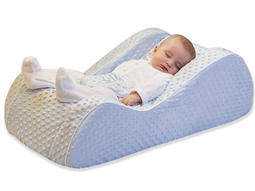
And yet it would be equally “restrictive” for the baby to spend most of the day lying in special infant cushions or car seats. Their back may be well supported, but without the chance to “take on gravity” babies may find it harder to build the muscle strength they need to support their head. According to the International Chiropractic Pediatric Association, spending long hours in such seats/bouncers can affect the healthy development of the spine.
Don’t get us wrong: this in no way means that a few walks with the pram or some hours in the bouncer will cause any harm! The truth, though, is that babies are greatly helped by our arms and by spending time upright. As mum walks, stops or changes direction, the baby’s body naturally works against gravity. Gravity exercises its muscles and helps it grow stronger, learn to support its head and control its body.

Think of very small, newborn babies. When we lay a newborn on its back, it draws its legs up toward its tummy in a “fetal position“. It’s the position that calms it and helps it most, both with digestion and with regulating its body temperature.

Exactly the same happens when we take a newborn in our arms, against our chest. The baby lifts its little knees and rests its tummy against ours. It’s the position that comes naturally to it — the position where it feels protected, comfortable and warm.
“So why does my pediatrician say no to carriers?”

There are a great many pediatricians who warmly support ergonomic carriers. But there are also some who, although they support the embrace, have little experience with carriers. When they think “carrier”, they may have in mind the conventional carriers of the ’80s and ’90s, which don’t offer adequate head support, have holes for the legs to hang through, and leave the baby dangling from the crotch with its legs falling down unsupported.

Especially when the baby faces outward, its centre of gravity shifts, the shoulders are pushed back, and because babies don’t have developed abdominal muscle tone, their back goes into hyperextension — the curve is the reverse of the natural one. All the weight is held by a narrow strip of carrier between the legs, and the baby is literally hanging.
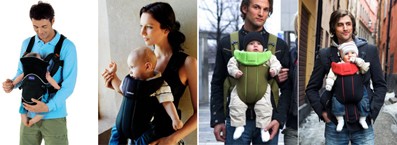
The photos above show the kind of carriers some doctors have in mind. Unlike ergonomic carriers (slings, mei tais, wraps, pouches or soft-structured carriers), in conventional carriers we often see the reversed curve of the back (hyperextension), the dangling legs and the unnatural tilt of the pelvis. Even though the baby enjoys being close to mum, the pediatricians who disagree with using such carriers are right!
In an ergonomic carrier, however

In an ergonomic carrier the baby is just as it is in our arms, with the fabric reaching to the back of the knee, supporting the legs properly. This helps the correct positioning of the pelvis and the spine. The position is perfectly natural.
According to Dr. Maria Blois and her research on premature babies placed upright in their mother’s arms, their breathing was better and steadier than in an incubator, episodes of apnea and bradycardia were clearly fewer, and oxygen uptake was exactly the same.
More generally, for all babies, the upright position in the arms has many advantages: babies like it more, it helps with reflux problems and with their sense of balance.
So why do we care so much about “not slouching”?
We care for the baby’s breathing! Imagine yourself in a very curled-up position: rest your chin on your chest and lean forward — you’ll find it hard to breathe. Especially for newborns who can’t support their little body well, it’s important to help them keep their airways open, keep their head from falling forward and not be folded onto their tummy.
Be sure to watch (with sound) the video below, which shows how a newborn’s back should be supported so it can breathe comfortably:

Here’s another reason why an ergonomic carrier should have an open tail and adjust freely — and one of the reasons a good ring sling is preferable for newborns over a pouch.
What the experts advise
The images below are translated from the International Hip Dysplasia Institute and show right and wrong, recommending carriers that support the leg up to the knee (like Asteraki Slings) for the correct hip position in babies.
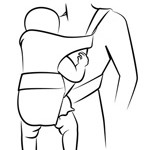
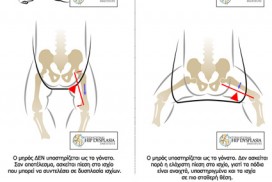
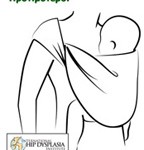
Read more about the correct hip position in the article “Legs apart in babies”.
Sources & further reading:
paidiatros.com — Plagiocephaly
iatrikionline.gr — Ortho 51 (PDF)
Blois, M. (2005). Babywearing. Pharmasoft Publishing.