Newborn babies in car seats, bouncers and other “containers” — stimulation and development
Article from the Babywearing blog, published on 22/09/2011
An ordinary day — from the baby’s point of view
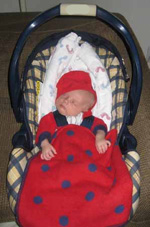
Picture a mum heading out in the morning to run errands with her baby. She puts it in the car seat, arrives at the shops, “clicks” the seat onto the pram, does her shopping. She returns, straps the seat back into the car, goes to a restaurant, sets the seat beside her chair and rocks it now and then. After a couple of hours the seat is strapped back into the car and they head home. The baby is asleep, mum doesn’t want to wake it — she carries it in the seat into the house. Later it will spend the rest of the day in the bouncer, until it’s time for the cot.
Now picture all this from the baby’s point of view: it spent its whole day (and night) lying in the same position, constantly seeing the same seat canopy, with minimal movement. (The car or pram was moving, but without a change of images the baby couldn’t perceive it!)
“Bucket babies” — and mum’s back
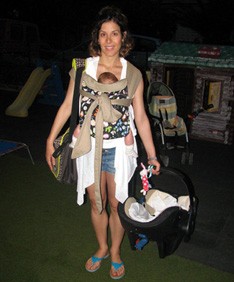
Abroad they use the term “bucket babies” for babies who spend a lot of time in seats of every kind (buckets or “containers”). Many articles by doctors talk about the trend they call “the containerization of infants”.
And from mum’s side: carrying the seat with the baby (in one hand, leaning to one side so it doesn’t bang against her legs) is one of the worst “exercises” for the back, wrists and elbows. The repeated bending to fit and remove the seat is an extra risk factor for back injuries. And how often do we end up carrying the baby in one hand and the seat in the other?
Why our arms are better
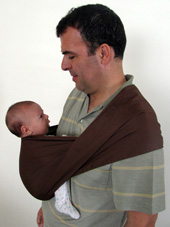
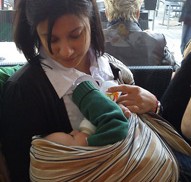
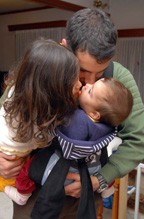
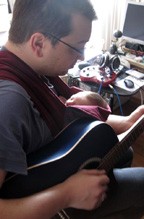
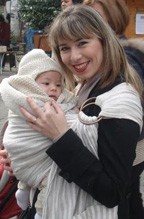
Is it better for the baby to be on us than in those super-ergonomic seats? In every respect, yes! Our soft babies are made to nestle in our arms, to burrow into mum’s chest, to settle against our neck. When we carry a baby, it senses the warmth of our body, the changes of position, the touch of our embrace, our movement — and it gets the chance to learn to balance its head and support its torso.
All the stimulation of being held (the kisses, the strokes, the position changes, the rocking side to side and up and down) almost disappears in the “seat”.
Most importantly: the movement we offer activates the vestibular system (inside the ear, which regulates balance) and helps the baby learn to balance, to sense changes of position and to hold its body in a neutral posture. It also learns to perceive distance as we approach or move away from objects, it understands space and movement, and later it’s encouraged to reach out its little hand and explore.
Without exaggeration
We don’t see babywearing and the pram or bouncer as mutually exclusive. There are times when a good pram or bouncer is the ideal solution, and no parent can hold their baby all day long. No exaggeration, no fanaticism and no “absolute” rule fits our way of thinking. But next time you go out, consider whether the car seat should stay… in the car.
Moments in our arms