
Below you will find instructions to make your own wrap to carry your baby. If you need any clarification, contact me, I’ll be happy to help! It’s very easy! Good luck!
Note: These instructions are intended for personal use only. My goal is to enable as many parents as possible to carry their babies, even if they cannot afford to buy a sling.
read here why Asteraki Slings are worth far more than they cost.
What should the fabric be made of?
Without sewing (if you can’t sew-hem the edges):
Choose a fabric that doesn’t “fray” at the edges, or whose edges “roll” (curl up) when cut. Such fabrics could be: medium-weight fleece, thick (strong) jersey knit, cotton jersey, cotton “gauze” (not the kind we put on wounds! but the thin, breathable fabric often used for curtains or summer clothes), etc.
With sewing (if you can hem the edges):
Almost any fabric you choose will do! Prefer a natural fabric that “breathes”. If you choose a fabric with some “grip” (i.e. one that doesn’t slip too much), it will make some positions easier. You’ll need to hem all the sides (or use an overlocker).
Stretchy or firm fabric?
Stretchy fabrics are more suitable for newborns or babies who generally don’t weigh much. They are very “comfortable” for your baby and allow you to support their little head without much effort, while they feel like a “second skin” on you.
With a stretchy fabric you can also put your baby in and take them out of the wrap without needing to untie it.
Even so, once your baby starts getting quite heavy, you’ll find that a stretchy fabric needs to be tied very carefully and “tightly” to be comfortable, otherwise it will “sag” a lot and tire you out. The stretchier the fabric, the more attention it needs when tying.
Also, very stretchy fabrics are generally not suitable for carrying your baby on your back. It’s rather better to use a firm fabric for those positions.
“Professional” wraps, which are made specifically for carrying your baby and have been designed for this purpose, have what’s called a diagonal stretch. This means that while they are firm in their length and width, they stretch at the corners. Some woven fabrics have this diagonal stretch. In theory, this type of fabric offers ideal support for your baby. In practice, though, if you tie your wrap well and tightly, hugging your little one, any firm or slightly stretchy fabric can be suitable.
What colour?
Whatever you like! Keep in mind that, especially in some positions, wearing your baby in a wrap can mean that the top you’re wearing barely shows and that you’re mostly “wearing” the wrap! So make sure you feel good about the colour you choose.
What’s certain is that the fabric you choose must look right in its colours from both sides. The way you tie it will result in both sides of the fabric being visible, so don’t choose a fabric with a “right” and a “wrong” side.
I find that stripes (whether horizontal or vertical) help beginners a lot in tying their wrap correctly. If you manage to find a striped fabric in which both sides are “good”, it’s ideal for starting to learn!
Finally, make sure your wrap washes easily in the machine! If all goes well you’ll be wearing it constantly and you may need to “get rid of” many stains!
Thick or thin fabric?
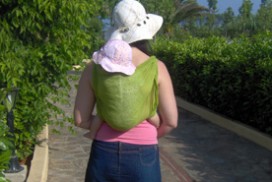 First of all, you should take the weather conditions into account. In Greece it never gets so cold that you’d need a thick fleece for your wrap. Remember, too, that in most positions your baby is wrapped more than once with the fabric (and those count as layers of clothing!).
You should keep in mind, though, that the thicker the fabric, the more comfortable it is. A thin fabric may “dig in” at pressure points if you’re not careful about how you tie it and spread it around your body.
In general, a good rule is that if you choose a thin fabric, it’s best to make it fairly wide. That way you can “spread” it as much as needed so it’s comfortable, or it will act as a “little cushion” when folded several times (e.g. on your shoulders in the high back carry).
How wide should the fabric be?
 It depends on the positions in which you’ll want to carry your baby. The width can usually range from 50 to 75 centimetres. In fact, in some positions it may be better to fold a very wide wrap in half. With 50 centimetres, for example, you can easily carry your baby in the double cross with a horizontal support pass. However, to carry your baby high on your back, you need at least 70 centimetres of width.
How long should the fabric be?
Again, it depends on the positions in which you’ll want to carry your baby. Usually 4.5 metres is the right length for all positions and for most people. If someone is particularly large (over 1.80 m and quite heavy), they may need 5 metres for all positions. Even so, with 4.5 metres they’ll be able to use their wrap in some positions. There are positions that can easily be done with a much shorter fabric, such as the simple cross carry.
CAUTION: Don’t buy a 2-metre-long fabric planning to cut it in half lengthwise and then sew the two pieces together to get a 4-metre-long fabric! Your wrap must have no seam, because that would be a seam bearing weight and tension (and quite a lot of it). It’s important that your fabric has the correct length from the start, even if that means you’ll have two wraps (if the fabric is double width), one to wear and one to wash, or one for dad and one for mum! (Even better, give the spare wrap to a friend and help spread babywearing too!)
You’re now ready to learn how to use it!
see instructions here: How to wear your wrap!